

Marketing for movers works when every lead is tied to a booked job. Record the source of each lead in your moving CRM, follow up within minutes, and judge each channel by cost per booked move rather than cost per lead. Moving leads cost about $20–$100 each in 2026, so a channel only pays off when enough of those leads book.
Most moving companies do not have a marketing problem as much as a tracking problem. Google Ads, a Google Business Profile, lead providers and realtor referrals all produce inquiries, but when those inquiries live in an inbox, a call log and a spreadsheet, nobody can say which channel paid for itself last month. This guide shows how to run marketing for movers from the system where leads, quotes and bookings already live: your moving CRM. It is written for owners and office managers who are not marketers, using MoversTech CRM as the example.
Moving company marketing channels at a glance
| Channel | Typical cost per lead (2026) | What to record in the CRM | Judge it by |
|---|---|---|---|
| Google Ads |
|
||
| Meta ads (Facebook, Instagram) |
|
||
| SEO and Google Business Profile |
|
||
| Lead providers |
|
||
| Realtor and customer referrals |
|
Why moving company marketing leaks without a CRM
Referrals and local ads still bring in work, but most movers now run more channels than they can track: an ads account, a Google Business Profile, one or two lead providers, a few realtor relationships and a list of past customers. Each channel produces inquiries. The leak happens between the inquiry and the booking.
Three things go wrong when leads are scattered across inboxes, phones and spreadsheets:
- The source is lost. Once it is written on a notepad, a lead from a $60 ad click looks the same as a free referral.
- Follow-up depends on who is in the office. Leads that arrive after hours or on a busy Saturday wait, while the customer requests quotes from other movers.
- Budget decisions are made on feel. Without booked moves per channel, the loudest channel keeps its budget, not the most profitable one.
The move acquisition system combines marketing and sales. Marketing generates leads through channels like online ads, SEO, social media and email campaigns. Sales manages and converts those leads with a clear process. When marketing and sales work together, you turn your efforts into real business growth.
The CRM is what connects the two. The rest of this guide follows that loop in order: capture the lead with its source, run the right channels, follow up fast, market to people who already know you, and measure what each channel returns.
How do you capture every lead with its source?
Tracking starts the moment a lead enters the business. If the source is not recorded then, it cannot be rebuilt later from memory.
In MoversTech, every lead carries a lead source, whether it arrives through your website form, from a lead provider, or through the API that connects other tools. Because MoversTech can capture leads from every source into one list, a provider lead and a lead from your own quote form follow the same rules and appear in the same reports. Set up the source list once, using names the whole team recognizes: “Google Ads”, “Google Business Profile”, “Website”, “Meta ads”, each lead provider by name, “Realtor referral” and “Past customer”. Keep it short. Eight sources used consistently are worth more than twenty used at random.
Phone calls need a process
Calls are where source data disappears most often. Two simple ways to keep it:
- A separate phone number per channel. Use one number on Google Ads, one on your Google Business Profile and one on the website and printed materials, so the number dialed tells you where the caller came from.
- One intake question on every call. Ask “How did you find us?” and pick the answer as the lead source before the call ends.
Either way, the call becomes a lead record with a source, the same as a web form.
Your website is where every channel converts
Ads, search and social all end up on your website. If the quote form is long, hard to use on a phone, or sends inquiries to an inbox nobody checks on weekends, every click costs more than it should. The basics: a short quote form on every service page, a visible phone number, and form submissions that go straight into the CRM as leads. If the site loads slowly on mobile or the form has not changed in years, fix that before raising any ad budget.
Which marketing channels should a moving company run?
No single channel is best for every mover. The right mix depends on your market, move types and season. What matters is that every channel is judged by the same number, and that the number comes from booked moves in the CRM.
Google Ads and Local Services Ads
Search ads reach people who are already looking for movers, which makes them the fastest way to fill a slow calendar. Google Ads leads cost about $30–$80 each. Local Services Ads work differently: you pay per lead instead of per click, and the ads usually appear at the top of the results. Tag every ad lead with its campaign, then cut campaigns that produce form fills but no bookings. Feeding booked-job data back into your campaigns is how movers use CRM data to improve paid ads, for example by excluding past customers or putting more budget into the areas that book most.
Economic downturns present a chance to gain market share. When competitors cut their marketing budgets, there is less competition for ad space and keywords, making PPC campaigns more affordable.
SEO and Google Business Profile
Organic search and the map pack produce the cheapest leads over time, about $5–$20 each, but take three to six months to build. The work starts with a complete Google Business Profile that brings in more leads: the right categories, service areas, photos and regular updates. It depends on collecting reviews from customers after every job, since review count and rating affect local ranking. SEO for moving companies then adds a service page for each move type and area you serve.
Meta (Facebook and Instagram) ads
Social ads reach people before they start searching. Meta leads cost about $15–$45 but arrive earlier in the decision, so expect a lower booking rate than search and judge them over a full quarter, not a week.
Lead providers
Bought leads fill gaps quickly, but shared leads go to several movers at once. Track each provider as its own source, and the shared-versus-exclusive question usually answers itself within a month or two. The same tracking quickly exposes the lead sources movers waste money on: the ones that keep sending leads but rarely produce a booked move.
Realtor and customer referrals
Referrals are the lowest-cost channel when they work. Record the referring agent or customer on each lead so you can see which partners send booked moves, and thank them accordingly. Movers who collaborate with realtors actively, sharing availability before busy weekends and reporting back on referred moves, get a steadier flow.
Why does follow-up speed decide what your marketing costs?
A lead you paid $50 for is only worth $50 if someone answers it. Even if your marketing attracts plenty of leads, they won’t become clients without a fast, consistent way to follow up. If your team responds slowly, potential clients lose interest or choose a competitor who answered first.
In MoversTech, a new lead can start an automated follow-up sequence: a confirmation to the customer by email or SMS, then follow-up messages and team reminders on the schedule you set. Replies come back to the same inbox the office already works from. Consistent response after hours and during the summer peak, when the office is busiest, is one of the main benefits of automated follow-ups in moving. Leads that go quiet after receiving a quote need a different message, and a few simple ways to nudge silent leads back into action recover bookings that would otherwise go to another mover.
Booking rate by source is the number marketing and sales share. If Google Ads leads book at 25% while referrals book at 60%, part of the gap is lead quality. If the same channel books well one month and poorly the next, check response time before you touch the ad budget.

How can past customers and referral partners become a marketing channel?
Every booked move adds a customer to your database, and moving is not a one-time purchase. Households move again, businesses relocate, and satisfied customers refer friends and neighbors. These are the cheapest leads you will ever get, as long as you stay in touch.
MoversTech lets you segment past customers and send email or SMS campaigns to each group. Segments worth building:
- Moves completed in the last 30 days: a thank-you and a review request.
- Moves completed more than a year ago: a check-in before the spring and summer season, the simplest way to re-engage lapsed customers before they start searching again.
- Commercial customers: a note about storage or the next office relocation.
- Realtors and property managers who referred jobs: a short quarterly update and thanks.

A standalone email tool tells you who opened a message. A CRM tells you who booked. Sending campaigns from the same system that holds bookings means a repeat customer’s next move is credited to “Past customer” instead of disappearing into “Website”. Writing each campaign from custom email and text templates for movers keeps the tone consistent no matter who on the team sends it.
How do you measure which marketing channel works?
Every marketing effort should be measured by what it returns. Cost per lead is the number vendors quote, but it is the wrong number to run a moving company on. Two numbers matter instead:
- Booking rate = booked moves ÷ leads from that source
- Cost per booked move = spend on that source ÷ booked moves from that source
Here is how that plays out in an example month with four sources (example figures within the 2026 benchmark ranges):
- Google Ads: $3,000 spent, 60 leads at $50 each, 15 booked moves (a 25% booking rate). Cost per booked move: $200.
- Shared lead provider: $1,500 spent, 100 leads at $15 each, 6 booked moves (6%). Cost per booked move: $250.
- Meta ads: $800 spent, 32 leads at $25 each, 4 booked moves (12.5%). Cost per booked move: $200.
- Realtor referrals: $150 spent, 10 leads at $15 each, 6 booked moves (60%). Cost per booked move: $25.
The provider sells the cheapest leads and produces the most expensive bookings. Based on what moving leads cost in 2026, a common target is keeping cost per booked move under 10–15% of the average move value, which is $120–$180 on a $1,200 local move. Google Ads and Meta at $200 are close; a few points of booking rate from faster follow-up would bring them under target. The provider at $250 needs fewer dollars or a switch to exclusive leads.
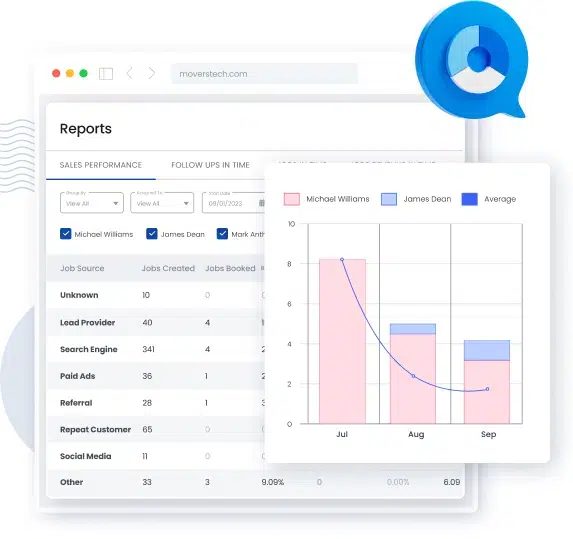
MoversTech moving company reports show leads, bookings and revenue by lead source (listed as job source in the sales performance report), so this table comes straight from the CRM instead of a spreadsheet. Add spend from each ad platform and the math takes minutes. Booking rate by source belongs on the short list of the most important reports in moving, reviewed every month alongside the rest.
How to run your marketing, even if you are not a marketer
You don’t need a marketing degree to succeed, but learning the basics is essential. Many moving company owners feel overwhelmed by platforms like Google Ads or Meta ads. Taking small, practical steps makes them manageable.
A monthly review of about 20 minutes is enough:
- Pull leads, bookings and revenue by source from the CRM.
- Add spend per channel and calculate cost per booked move.
- Move budget from the weakest channel toward the strongest, in small steps.
- Check response times for the month. If they slipped, fix that before changing budgets.
You can also work with vendors, such as SEO agencies, PPC managers or lead generators. Understand enough about their services to judge the results, and ask them to report booked moves from your CRM, not clicks or impressions.
Marketing for movers starts with knowing where moves come from
Marketing for movers does not need more channels. It needs a closed loop: every lead captured with its source, answered fast, and traced to a booked move and its revenue. MoversTech keeps leads, sources, follow-up and booking reports in one moving CRM, so the monthly review takes minutes instead of a weekend with spreadsheets.
Frequently Asked Questions
How do you market a moving company?

Marketing for movers starts with a small set of channels that fit your market, usually search ads, Google Business Profile and SEO, referrals and past customers. Record the source of every lead in a moving CRM, follow up within minutes, and compare channels each month by cost per booked move. Shift budget toward the channels that book, not the ones that produce the most leads.
Are Google Ads worth it for moving companies?
Usually, for movers that follow up quickly. Google Ads leads cost about $30–$80 each in 2026. At a 25% booking rate, that is $120–$320 per booked move. The ads pay off when that number stays under roughly 10–15% of the average move value.
What tools do moving companies use for marketing?
Most use a moving CRM to hold leads, lead sources and bookings, plus ad platforms such as Google Ads, Local Services Ads and Meta, and a Google Business Profile. In MoversTech, email and SMS campaigns to past customers run from the CRM. For phone leads, a separate number per channel or a "How did you find us?" question at intake keeps the source.
Should moving companies use Facebook ads?
Facebook and Instagram ads, run through Meta, work best as a second channel next to search. Meta leads cost about $15–$45 each in 2026, but people seeing them are earlier in their decision, so they book less often than search leads. Retarget website visitors and past customers, and judge the results over a full quarter by cost per booked move.